
Searching for a Warrant in Lyon County
A Lyon County case starts at the MCRO Case Search screen. Pick the name tab for a person. Pick the case, citation, or attorney tab when an identifier is already in hand. Before searching, narrow the court location to Lyon County.
- Open MCRO Case Search and pick one tab: name, case number, citation number, or attorney.
- Enter the exact name, or the complete case or citation number. Complete numbers work with or without dashes.
- Set Court Location to Lyon County, and add a case category or filing date only if the first search returns too much.
- Select Find, then read the result cards for case number, type, filing date, court location, and the View Case Details control.
- Open Case Details and review the Warrant section, case events, and bond activity before drawing a conclusion.
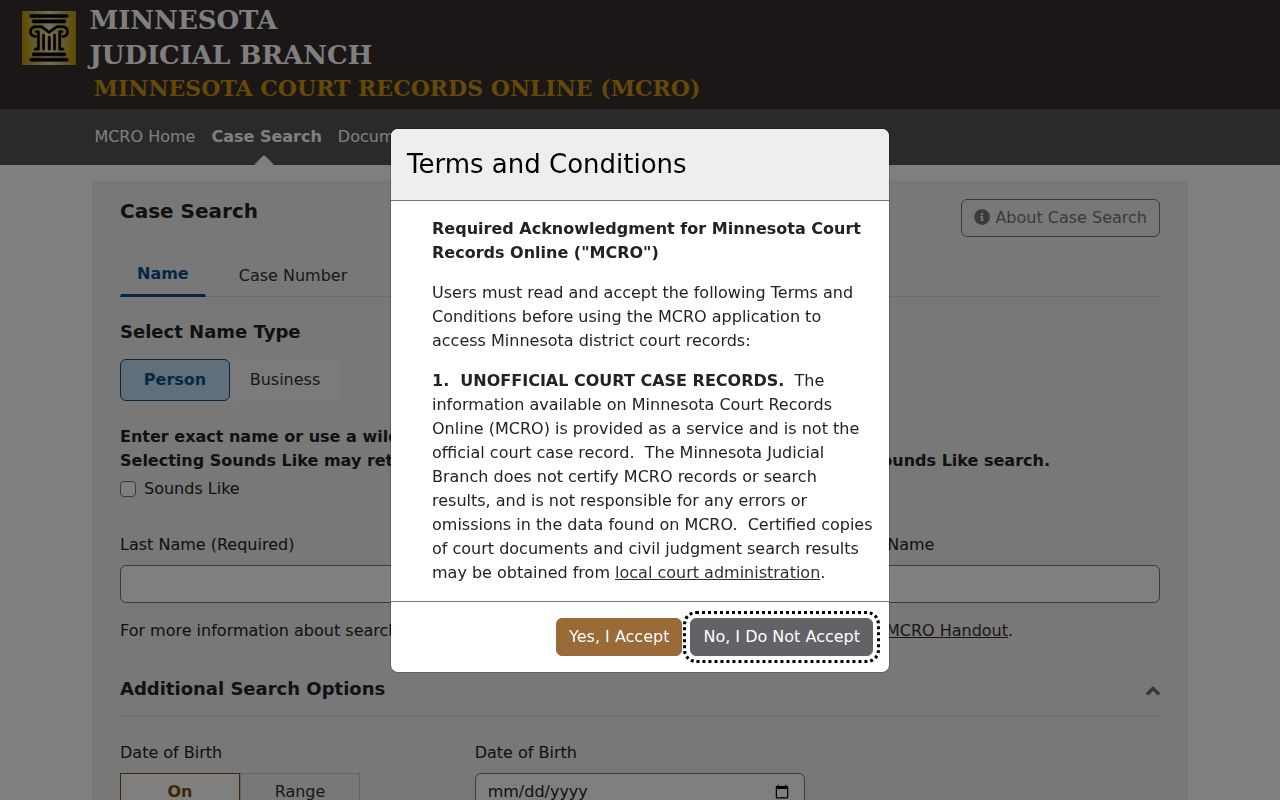
The Minnesota Court Records Online case search is where a Lyon County warrant flag first appears. The official page shows each case with its Warrant section.
Tabs matter here. A defendant-name search is restricted in some pending criminal matters, while a case or citation number still works. For the current list of remote-access exclusions, see the MCRO access overview.
Note: A search that returns nothing settles nothing. Scope, spelling, and filters explain most empty results.
Lyon County Warrant Name Search Variations
MCRO matches names exactly, with no guessing. That one design choice explains most failed Lyon County warrant searches. The same person can show up as Katherine in one case and Kate in another, and punctuation adds its own wrinkle. Two tools fill the gap, and they cannot be combined. A wildcard placed after at least two characters widens a stem, so John* picks up Johnson and Johnston. The Sounds Like option instead hunts close spellings. The state's name-search guidance also suggests trying a full middle name first and then a middle initial, since the fields are separate. Married names, hyphenated names, and suffixes born of a data-entry choice all appear in real case files. Before concluding no Lyon County case exists, run the search with and without them.
Warrant Search Fields Explained
The search form looks short. Then you notice how many ways one question can be asked. These are the controls a Lyon County searcher will actually use.
| Field | What It Does | Notes |
|---|---|---|
| Search tab | Chooses name, case number, citation number, or attorney | Pick one |
| Name type | Separates a person search from a business search | Required for name searches |
| Last and first name | Exact name matching | Middle name sits in its own field |
| Middle name | Narrows or widens the match | Try both forms |
| Sounds Like | Finds close spellings | Cannot combine with a wildcard |
| Wildcard | Widens a name stem | Place after two characters |
| Date of birth | Exact date or a range | Use only for the person's own record |
| Case category | Civil, criminal, family, probate, mental health | Optional filter |
| Court location | Statewide or a single county | Select Lyon County |
| Case or citation number | The most precise identifier available | Complete numbers only |
Filtering to Lyon County keeps a result list short enough to read.
Lyon County Case and Citation Searches
When a defendant-name search is unavailable, the case number becomes the way in. Minnesota restricts remote name access for some pending criminal matters, and the same rule keeps a warrant flag hidden until the right identifier is supplied. A Lyon County traffic or petty case with a printed number fits the citation tab. Use the complete number from the citation. If the first attempt fails, try it with and without dashes. An attorney search helps when the name is common and the case list runs long.
Note: A case or citation number turns a restricted or crowded search into a single predictable result.
What a Warrant Search Shows
A public Lyon County case may show a warrant flag and a full Warrant section. Or it may show charges with no warrant information visible remotely.
| Case information | Case number, title, category, court location, filing date, and judicial officer |
|---|---|
| Party information | Party names and roles, with restricted fields omitted |
| Warrant section | Warrant status and the issue, modification, or inactivation events behind it |
| Charges | Offense, statute, and classification |
| Bond and bail activity | Amounts and statuses such as posted, forfeited, or discharged |
| Hearings and events | Appearance dates, case events, and later status changes |
A flag on a party is not the same as a warrant in that case. The court's own handout warns the indicator can point to a different matter. That is why the Warrant section in a Lyon County file deserves a careful read.
When Lyon County Sheriff Records Fits Best
The Lyon County Sheriff holds law-enforcement records: reports, arrests, service documents, and booking information. The court holds the case file and the warrant status inside it. Send a request to the wrong office and it comes back as a referral rather than an answer. Ask the Records Division in writing, and describe one existing record. The sheriff's office sits at 611 W. Main Street, PO Box 28, Marshall, MN 56258, with a fax line at (507) 537-7428 and a main number of (507) 537-7666. Include a case number, citation number, date range, or document type so the office can locate what you described. Inspection of public data is free under Minnesota law. Copies can carry the actual cost of searching, retrieving, and producing them.
Where to Check Warrants in Lyon County
Five offices answer different versions of the same question. Lyon County District Court, at 607 W. Main Street in Marshall, owns the case and the warrant status; call (507) 706-7050. The Lyon County Sheriff handles service and law-enforcement records at (507) 537-7666. The county jail answers custody and bond routing questions at (507) 929-6623. The Minnesota Court Payment Center handles payable citations, and the state's criminal-justice network carries warrant data the public cannot search. The practical rule is simple. Status questions go to the court, service questions to the sheriff, custody questions to the jail.
Jail Rosters and Lyon County Warrant Searches
People confuse the county jail roster with a Lyon County warrant list often enough that it needs its own warning. The roster is a custody list. The county says it refreshes every 12 hours, and Tracy's police page describes its linked roster as updating at 4 a.m. and 4 p.m. Neither statement has anything to do with outstanding warrants. The two records can diverge in both directions. A person can sit in custody on one charge while another case still carries an active warrant, and a warrant can stay active long after release.
Restricted Warrants and Access Rules
Minnesota presumes that government data are public. Warrant files are the big exception. A Lyon County warrant search can come back empty because the record is restricted, not because no warrant exists.
Key Rules:
Minn. Stat. §13.03 - public data may be inspected at reasonable times, and inspection carries no fee.
Minn. Stat. §13.82 - arrest-warrant index data are confidential until the person is in custody, served, or appears.
Minn. Stat. §260B.171 - juvenile records follow their own access rules and are largely outside public inspection.
Not every Lyon County court record is online. Civil commitment, domestic abuse, harassment, and some juvenile and CHIPS files stay off remote access. A Name Not Available Online notice sends you to a courthouse terminal or the court administrator.
Lyon County's Missing Statewide Warrant Database
Minnesota has no statewide public warrant list. Counties do trade warrant information. But the sharing runs through the Bureau of Criminal Apprehension criminal-justice network, which stays closed to the public. The MNJIS Warrant Service exists for law-enforcement agencies, and Minnesota Statute §299C.115 is the rule behind the sharing. So what can a Lyon County reader do? Search the case in MCRO first. If the record is unclear, call Lyon County District Court, and use the sheriff's records channel for a law-enforcement record. A missing statewide list is a gap in the system, not a gap in your search.